Scaling Software Training Content Across Global Distributed Teams
Standardize structure instead of content to keep training fresh as software changes.
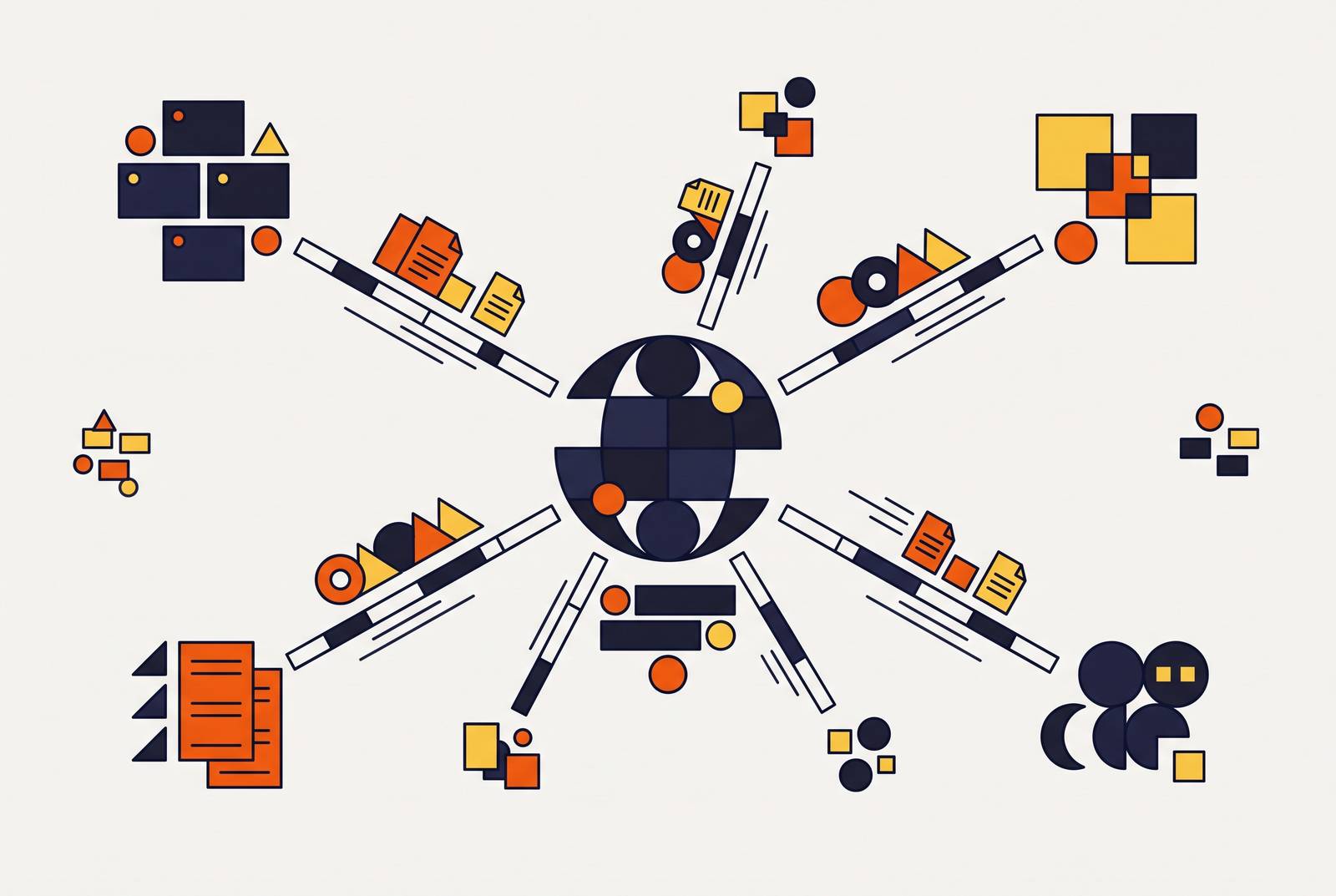
Standardization gets confused with uniformity constantly, and that confusion kills more training systems than laziness ever does. Standardizing content means every region builds on the same skeleton: format, quality bar, and update cadence stay fixed even as the specifics shift by audience. One region can build on that skeleton without ever watching the same video as another.
A real content standard needs a taxonomy first. That means a clear list of what content types exist (onboarding video, SOP, process walkthrough, release note) and what job each one does. Skip that step, and teams reinvent formats every time someone has to explain a new feature. The library turns into a junk drawer within a year, and nobody notices until they're digging through it looking for something that should've taken thirty seconds to find.
Modular architecture matters more, and it's where most teams get it wrong. Each piece of content should cover one task or one concept, nothing more. That sounds like a small design choice, but it changes everything downstream: a module gets updated or retired without touching the course wrapped around it. Move a dropdown menu in the product, and a modular library lets a team swap out that one screen-capture segment. A non-modular course means someone re-records the whole forty minutes, or lets it rot in plain sight, and most teams choose rot. Re-recording everything is too expensive to justify on a random Tuesday.
Software training needs modularity more than almost any other kind, because interfaces move on sprint cycles, not annual ones. A monolithic course goes stale one screen at a time, and nobody notices until a new hire in São Paulo is staring at a button that no longer exists.
None of this holds without an answer to one governance question: who owns the canonical version of each module, and what triggers a review? Skip that question, and the standard becomes a document sitting in a shared drive that nobody opens after the kickoff meeting. Standardization sticks when it's built into the production toolchain itself, reinforced through habit and system design.
Building the localization layer as infrastructure, not as a separate project
Here's the failure mode almost everyone runs into: English content gets finalized, and only then does someone file a ticket for translation. That ticket sits for weeks. By the time it's done, the English version has already changed twice, and the regional team is now training people on material that was outdated before it even shipped.
Localization stops being a bottleneck the moment it's built into the content system, handled continuously instead of remembered as a downstream task eventually. That starts with separation: keep narration and text apart from the visual assets, so translating a module doesn't mean re-editing the video underneath it. Voiceover and captions get generated from the script rather than burned into the footage, which turns a language swap into a configuration change instead of a full production job. One-click translation tools built at the platform level have made that shift real; a job that used to be its own project collapses into a single step.
Translation alone isn't localization, though, and treating it as the whole job is the mistake most teams make. Terminology drifts by region: feature names, UI labels, workflow names don't always match across markets, even inside the same product. Screenshots need to reflect the actual product version or configuration a given region runs, not whatever happened to be live when the original was filmed. Some regions carry legal requirements, mandatory disclosures or signed acknowledgments, that others simply don't have.
Async delivery and localization were built for each other. A learner in Singapore watching a module at 9 a.m. local time doesn't have a live facilitator standing by to explain a gap in the material, so the content has to stand on its own. That constraint is exactly what makes async localization scale: a team that bakes localization into production from day one adds new markets without adding headcount to match.
Why async video is the most effective format for distributed software training
Video is the default format for workplace training now, and the debate over whether it should be is basically over. Somewhere north of 90% of organizations use it, a sign of how completely it's replaced the text-heavy manual nobody read anyway.
For software specifically, video does something text struggles to do. A screen-capture walkthrough shows the exact sequence of clicks a learner needs, in order, closing the interpretation gap a written SOP always leaves open. One 2026 study found companies using AI-powered video training saw time-to-competency drop by around two-thirds, with notably higher retention than text-based training. Short-form video also matches how distributed employees actually consume content: in five-minute gaps between meetings, not a scheduled two-hour block that requires clearing a calendar.
Async video carries specific advantages for teams spread across time zones. Record it once, and it's available to anyone, anywhere, at any hour, no scheduling required. Every learner hears the same explanation instead of a version filtered through whichever facilitator happened to run that session, and learners can replay a single step, which matters enormously when the workflow has eight steps and step five is the one that trips everyone up.
Here's the part most rollout plans skip: self-paced eLearning tends to land in the 30 to 40% completion range, while cohort-based training reaches 60 to 80%. That gap is a warning, not a footnote. Ship async video without a clear path and some accountability wrapped around it, and the library turns into something nobody finishes. Pair the walkthrough video with a companion article or SOP, video to build understanding, article to reference while actually doing the task, and completion holds up. Skip that pairing, and the whole thing runs on hope.
How AI production tooling changes what a small team can realistically ship
The traditional production chain, script, record, edit, caption, add voiceover, export, has always been the bottleneck. Each step needs a specialist or a lot of time, which makes frequent updates expensive enough that teams put them off. That's how training libraries end up describing software that stopped existing two releases ago, and everyone just quietly accepts it as the cost of doing business.
AI production tools break that math. Teams using them report shipping five to ten times more content with the same headcount, which turns continuous maintenance from a nice idea into something a normal team can actually sustain. The automation eats the parts that used to consume most of an editor's week: cleaning up a script from a raw recording, generating a lifelike voiceover in multiple languages without booking studio time, applying smart zooms and captions automatically, producing a companion article from the same source recording alongside the video.
A few platforms show the range here. Colossyan focuses on training video with avatar and voiceover support and fast multilingual turnaround, useful for policy and product content that shifts often. Leadde.ai converts documents and scripts straight into training video, supports translation into dozens of languages and more than 200 AI avatars, with version control built into the workflow instead of bolted on after the fact. Other AI-powered platforms take a screen recording and turn it into a polished video and a step-by-step written doc in the same pass, generating voiceover, captions, and the companion article together, the clearest path for teams that need both formats without doubling production load.
The real payoff shows up at the update cycle. When a UI changes, a team with AI tooling re-records the one affected segment and regenerates the script, voiceover, and article around it, instead of rebuilding the whole course from scratch. What AI still can't do is decide what to teach, in what order, and for whom. That judgment stays human, and it's not close. AI handles execution; curriculum design stays a human call, and treating it otherwise is where teams get burned.
Distributing content production ownership to regional and functional teams
Centralize everything, and the L&D team becomes the single point of failure for every content request from every region and every department. That's the trap, and the math behind it is simple: one team can't keep up with ten regions and five functions indefinitely, no matter how good the tooling gets.
Distributed ownership means regional teams produce and localize their own content without routing every request through headquarters first. Customer success, sales enablement, and product teams build their own walkthroughs and SOPs inside a shared template, working in parallel rather than queuing behind everyone else's requests. The central team's job shifts toward maintaining standards, reviewing what gets published, and keeping the library organized, rather than producing everything itself.
This only works if the toolchain stays consistent across teams. Hand five regional teams five different tools and formats, and decentralization just multiplies the inconsistency problem instead of fixing it. That's exactly why the standardization layer has to come first, not after. There's a training dimension too: over half of companies in 2025 trained employees on asynchronous communication methods, which mirrors the content problem exactly. The people producing distributed content need real preparation, not just a camera and a deadline.
Subject matter experts deserve a bigger role here than most orgs give them, and this is worth arguing for directly instead of hedging. The person who runs the software workflow every single day is the best person to record the walkthrough, full stop. AI production tools remove the old excuse that SME-recorded video looks too rough. SME-driven content also stays current longer, since the person recording it is the same person who'll notice next month when the UI changes underneath them.
None of this works without guardrails, though. Every published module needs an approval step before it lands in the LMS, a named owner responsible for keeping it current, and a shared library that stops five teams from independently recording the same walkthrough because nobody checked what already existed.
Structuring learning paths so regional learners get relevant content, not everything
Solve the production bottleneck, and a new problem shows up right behind it: too much content, badly organized. A catalog with 400 videos isn't more useful than one with 40, if learners can't find the ten that actually apply to them.
Good learning path design starts with segmenting by audience. A first-time user in a market that just launched needs a different path than a power user or an account admin at headquarters, so map content to role and stage, not just topic. Where product versions or compliance rules differ by region, the path should branch there too, matching what's actually on the learner's screen. Onboarding should cover the critical path to first value and stop there; advanced material can exist without being mandatory before someone's ready for it.
AI-driven personalization is making a real dent here, with platforms surfacing the right content instead of leaving learners to dig through a catalog alone. That 30 to 40% self-paced completion rate from earlier isn't just a number to report upward; it's a design signal. Low completion usually means the path is confusing or the content doesn't feel relevant to the learner's actual job. Motivation is rarely the missing piece here, and blaming the learner is the easy mistake, wrong almost every time it gets made.
The LMS is the delivery infrastructure underneath all of this, and it's grown accordingly: the market was expected to reach around $28 billion by 2025 and is projected to approach $70 billion by 2030. But an LMS is only as good as what's loaded into it and how that content is structured. Buying a bigger pipe doesn't fix a content problem sitting upstream of it, and no vendor demo will tell you that part.
Keeping content current when software products change constantly
Staleness is structural, not a discipline failure, and it's worth saying that plainly instead of blaming the team. Traditional video production costs enough in time and money that teams delay updates, and delayed updates mean new hires this quarter learn last quarter's interface.
Fixing that takes a maintenance system, not good intentions. Named content owners should get notified when the relevant feature changes, catching staleness before a new hire complains three weeks in. Modular content means a single UI change triggers a one-module fix instead of a full rebuild, and AI production tooling turns that fix, re-recording a segment, regenerating a voiceover, updating captions and the companion article, into a job measured in minutes instead of days.
Inefficient process documentation costs companies real time and money every year, and a lot of that cost comes from employees hunting for information that turns out to be outdated once they find it. That cost multiplies across a distributed team, where there's no coworker three desks away to mention the doc is wrong before someone wastes an hour on it. Version control has to be non-negotiable here: every module needs a version number, a last-reviewed date, and a scheduled review trigger, running on a schedule rather than waiting for someone to notice a problem and complain loud enough.
There's a signal value buried in all this too. Teams that ship updated training alongside every product release are telling their users and their own employees, implicitly, that education is part of the product. Teams that don't are telling them the opposite, whether they mean to or not.
Measuring whether the training system is actually working across regions
Most organizations measure the wrong thing, and this is worth being blunt about. They track production volume, how many videos got made this quarter, when the number that actually matters is whether learners got competent faster or support tickets went down. Volume is the easiest thing to count and the least useful thing to know, and mistaking one for the other is the single most common measurement error in the field.
The metrics that reflect real system health look different. Completion rates broken out by region expose localization failures or path design problems specific to one market, invisible in a global average. Time-to-competency by cohort answers a sharper question: are new hires in remote regions reaching proficiency at the same pace as the ones at headquarters, or is there a lag baked into the system nobody's naming? Support ticket volume, tracked against training completion, is one of the clearest signals available; organizations using AI-powered training platforms have reported ticket reductions upward of 20%, a direct line from better training to less support load.
Content freshness deserves its own line item too: the percentage of modules reviewed within their scheduled cycle, tracked over time. A system that's actually working shows that number climbing steadily. A system that's failing shows a team scrambling every time an audit reveals how much has quietly gone stale, and by then, the cost has already been paid.