Multilingual Software Training Programs Without Separate Production Runs
One master source eliminates redundant production cycles for each language version.
Multilingual software training breaks down the same way almost every time: a team builds one great English course, then tries to copy it into five other languages using the same manual process that built the original. The fix isn't a better translation vendor. One master source feeds every language version on its own, so localization turns into a production stage, not a second full project. This piece walks through why the old model fails, what the single-master model needs, and how you measure whether it's working once it's built.
Why per-language production runs collapse under real-world training demands
Picture an L&D manager who just finished the English cut of a compliance module: script approved, screen recording clean, voiceover locked. The traditional model treats localization as a second production run for each target language: translate the script, re-record the voiceover, re-time every animation, update every on-screen label, re-export the whole file. Do that six times for six languages, and the English module that took one cycle to build now takes seven.
When you add a language, weeks of coordination have to pass before anyone translates a single word. Subject-matter experts need to confirm that technical terms survived the trip into a new language. None of that is translation work. It's scheduling and approval overhead that stacks up before the real localization even starts.
Then the product changes, and the system shows its real weakness. Within months, regional academies are teaching a version of the product that no longer exists. Employees in non-primary markets end up learning from stale screenshots and outdated steps, or they learn from ad-hoc translations that someone on the regional team cobbled together.
Teams respond to this cost by localizing less than they should. In compliance-heavy fields, manufacturing, healthcare, logistics, software security, that's not a minor comprehension gap. An undertrained regional team in one of these domains carries real safety and regulatory exposure, not just a knowledge deficit.
What the single-master model means in production terms
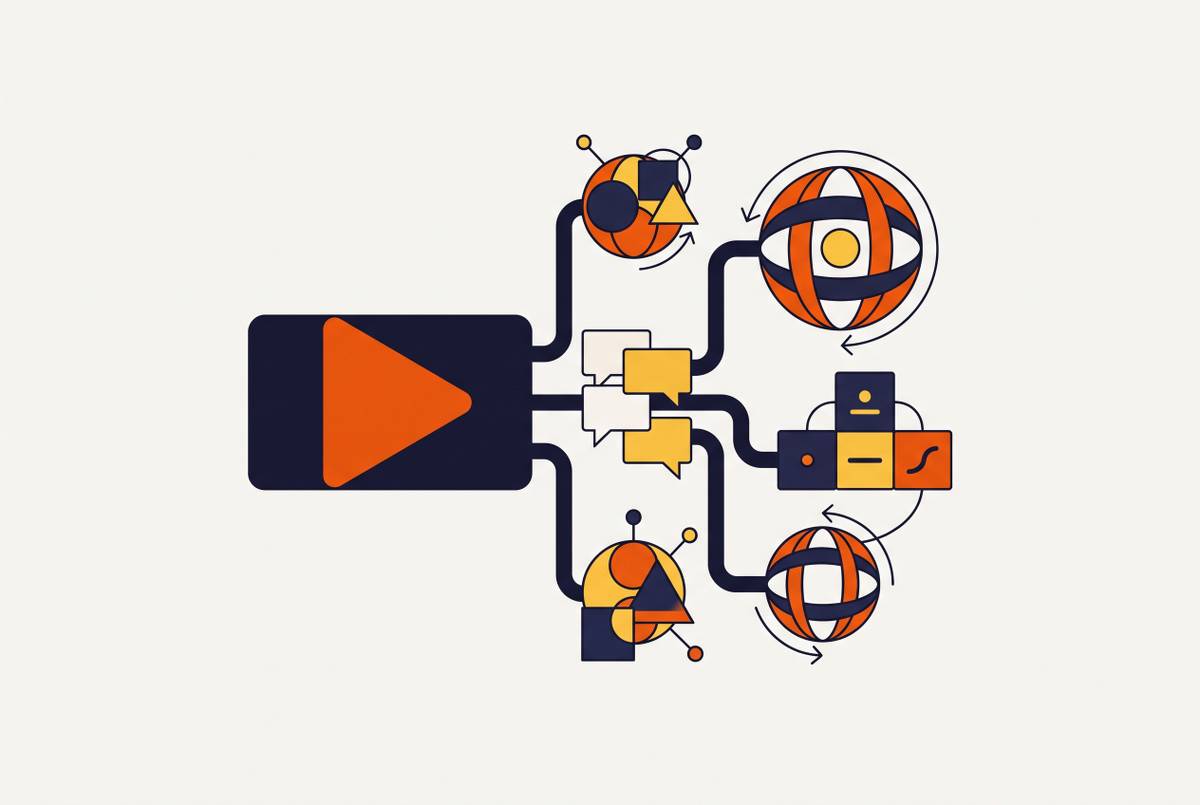
The single-master model changes what the actual unit of production is. Instead of treating each language as its own video project, you maintain one structured source asset, a script and transcript, and generate every language version from it. So localization is no longer a parallel production effort; it becomes a downstream step that runs off a locked master.
That downstream step breaks into five layers: transcript generation, translation consistency, voice localization, interactive adaptation, and regional analytics. Each layer feeds the next, and you can run, review, and improve each one on its own without restarting the whole pipeline. This sequence is what gives teams a repeatable production model instead of a bespoke project every time a new language gets added.
So you catch a terminology error once here, instead of catching it six separate times across six language versions after it's already propagated.
The anti-pattern this replaces is what happens when teams clone a course site for each language. Cloning produces multiple independent masters that look identical on launch day, but they start to diverge right after. Platforms like Clueso operationalize this directly: upload a screen recording once, and the AI generates a clean, approved transcript, then applies one-click translation across 33+ languages to produce localized video versions as downstream outputs of that single master. The master locks once, and language variants flow from it automatically.
Designing the master recording so localization doesn't break it
Most localization failures start with decisions you make while recording the source video, long before translation enters the picture. If you get the master wrong, every downstream language inherits the same flaw at once.
On-screen text is the clearest example. If you keep text in an editable layer, that same label updates in place, across every language version, and you never touch the underlying footage. That difference decides whether a five-language rollout takes you a day or a week.
Source audio quality matters just as much, and for the same multiplying reason. Background noise, inconsistent volume levels, and uneven pacing all degrade AI voice cloning, and they degrade it identically in every target language at once. A script that reads cleanly in English can still fail in translation if it leans on idioms, cultural references, or colloquialisms that have no clean equivalent elsewhere. Translators are forced into approximations, and approximations in technical training content mean reduced precision exactly where precision matters most.
Length planning deserves attention too. A localization tool that can't reposition captions so they don't cover the exact button or menu a learner needs to see creates a new production problem in every single language, not just one.
For screen-recording-based training specifically, record at a consistent zoom level and avoid using mouse movement as the only cue for where attention should go. AI smart-zoom applied after the fact can only target the right area of the screen when the source recording was deliberate about framing to begin with. Source audio quality and text layering decisions made during the initial recording function as infrastructure: poor audio or burned-in text forces manual repair work in every downstream language version, which erases the efficiency the single-master model was built to deliver.
Terminology consistency in the source script is the single upstream discipline with the largest downstream payoff. A term used inconsistently in English gets translated inconsistently in every target language, and the error multiplies by the number of languages in the pipeline.
How AI handles the five localization layers
AI has made four of the five localization layers fast and cheap to run. Most tools skip the fifth layer, interactive adaptation, entirely, and skipping it is most responsible for turning a finished training module into a video with no training function left in it.
AI transcription handles Layer 1, transcript generation, reliably when the language pair is standard and the source audio is clear. The human checkpoint here is about approving terminology before translation starts, since that's the point where a wrong term gets locked in for every language that follows.
Neural translation handles Layer 2, translation consistency, well when you have standard training prose in common language pairs. Less-common language pairs and highly technical content both call for human expert review before anything gets published.
Layer 3, voice localization, covers AI dubbing and voice cloning, which can preserve a speaker's identity and apply lip-sync alignment convincingly. What separates platforms now is whether on-screen text gets handled with the same fidelity as the audio, not whether the voice sounds natural.
Layer 4, interactive adaptation, is where most AI translation tools stop working. Quiz logic, branching scenarios, compliance checkpoints, and SCORM tracking all have to survive the localization pass intact. A localization run that translates the language but drops the interactive structure hands back a video, and for compliance training specifically, usability depends on that interactive structure surviving intact.
Compliance and safety content carries its own rule on top of all five layers: qualified human review of AI-generated audio and translation before distribution isn't optional when regulatory accuracy is on the line. Cultural adaptation also sits apart from linguistic translation as its own problem. A script built around urgency and fast pacing can translate accurately word for word and still land wrong in a market where relationship-building pacing is the norm. That's a script-level decision a human has to make, not something a translation tool can resolve on its own.
Where the workflow breaks down in practice
The single-master model introduces its own failure modes, and they're easy to miss because they look like localization quality problems when they're actually workflow architecture problems.
The analytics gap is the one that catches teams off guard most often. A global completion rate can look perfectly healthy in aggregate while it is failing for one specific language version underneath. Per-language analytics, not aggregate reporting, is the only way to catch a terminology error, an audio failure, or a SCORM issue in a single language before it turns into a support escalation or a compliance audit finding.
The visual layer gap appears right alongside the analytics gap. Audio translation has become a commodity. Platforms vary widely in whether they can update on-screen labels, UI captions, and diagram text without the original project files, and in whether they can restyle translated text to match your existing brand guidelines.
The update cycle trap undoes the single-master model from the inside out. The model only eliminates drift if the update process itself is centralized. A team that updates the English master correctly but still applies localization by hand to each language version has rebuilt the per-language production problem inside a new architecture, just with extra steps.
Localized videos that fail to load correctly in the LMS, or that lose learner tracking data on specific language versions, occur often enough that testing each language version in the target LMS before publishing is a required QA step, not an optional one.
Voice quality functions as a trust signal more than a polish detail. An accent that sounds unnatural or mismatched to the speaker's identity makes learners disengage, and the training loses credibility fast. You need to choose voice selection and regional variant matching deliberately, not leave them as settings on default.
One objection comes up constantly: translation quality for some language pairs isn't good enough yet to trust. For most teams, a reviewed AI translation with human expert review that reaches a regional team within days beats a flawless translation that arrives six months after the English version, or never arrives.
What a functional multilingual training pipeline looks like
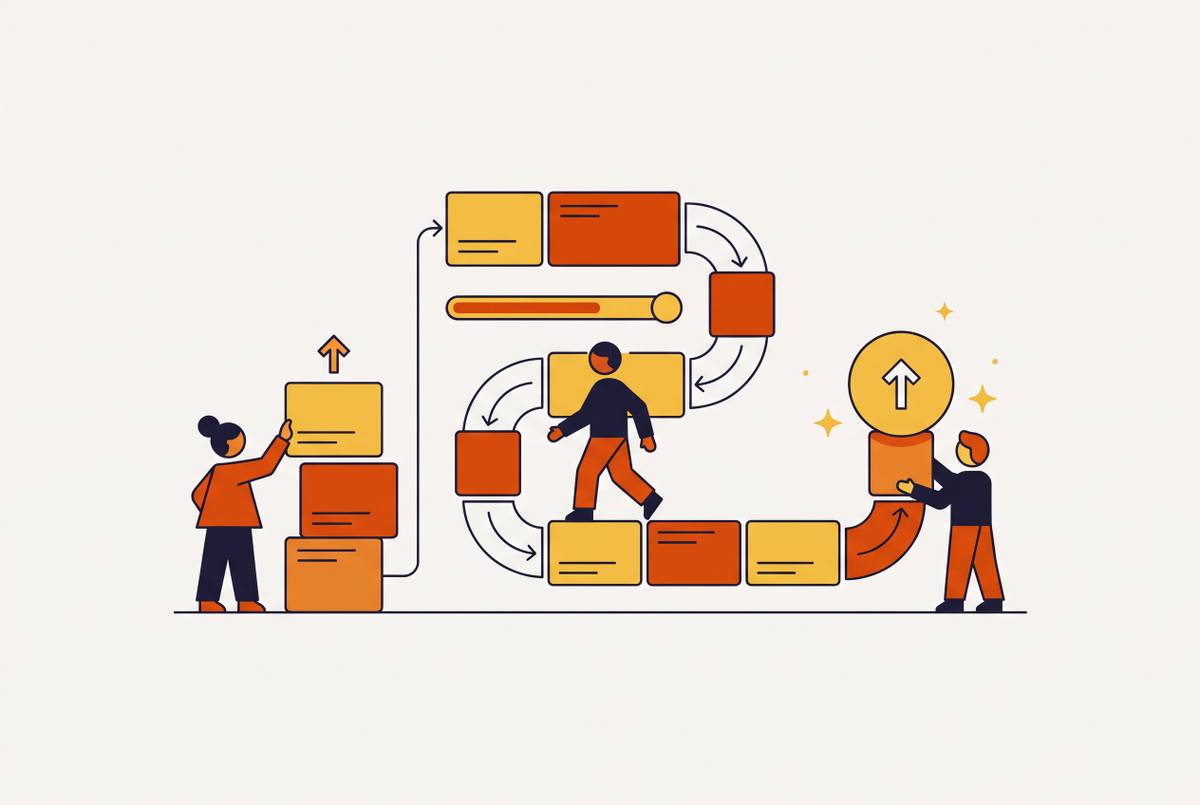
A working multilingual pipeline is a sequence of stages, where each stage gates the next one.
Stage 1 is source content creation. Clueso's workflow fits here directly: record, let the AI rewrite the script, add voiceover, and generate an accompanying SOP article, producing both the video and the documentation asset from a single pass.
Stage 2 is transcript review and terminology lock. A human reviews the AI-generated transcript before any translation runs. This is the highest-leverage quality gate in the whole pipeline, because an error caught here never gets the chance to appear in six languages at once.
Stage 3 is translation and voice generation: the locked transcript feeds one-click translation across target languages, so you get voiceover and captions in each.
Stage 4 is the interactive layer and SCORM packaging. You confirm that quiz logic, branching paths, and compliance checkpoints stay intact in each language version, then you package them for LMS delivery with per-language tracking turned on.
Stage 5 is per-language QA. Each language version gets tested in the actual target LMS. Audio quality, subtitle timing, on-screen text placement, and SCORM data capture all get checked individually, and compliance content gets routed to a qualified human reviewer before it goes live.
Stage 6 is publishing with per-language analytics, deploying with tracking that shows completion, engagement, and drop-off by language version.
The update model closes the loop: when the source content changes, the process returns to Stage 1, and localized versions regenerate from the updated master instead of requiring independent revision in each language. That regeneration step is the actual operational proof that the single-master model is delivering the maintenance advantage it promises. Scaled up, a product training library localized into several target languages multiplies into a large output set, but the single-master model means that whole library is maintained as one set of source assets, not as several independent catalogs aging at different rates.
Measuring whether the multilingual pipeline is working
The analytics gap flagged earlier points directly at how measurement has to work here: a single blended completion number can't tell a team whether the French version or the Japanese version is the one quietly failing. If you tie per-language signals to actual product behavior, you can see whether localized training produces the same outcomes as the English original.
Completion rate by language is the first number to pull, but it only flags that something's wrong. It doesn't say what. A low completion rate in one language could trace back to terminology, audio quality, cultural fit, or a technical SCORM failure, and finding out which one requires checking the other signals, not just this one.
The strongest framework compares product usage between trained and untrained cohorts inside the same language market: feature adoption, login frequency, how actively an account uses the product. If that gap appears clearly in some language markets and disappears in others, the localization quality in the weaker markets is the likely explanation. Trained customers, measured this way, tend to show better engagement and retention than untrained customers in the same cohort.
Support ticket volume by language or region gives you an indirect but dependable check. Well-trained users file fewer basic support requests. A spike in tickets from one specific language market right after a content update usually means the localized version of that update didn't land the way it was supposed to.
For compliance training, per-language audit trails and completion records are frequently a regulatory requirement, not just a quality nicety.
Reporting localization results works best when tied to outcomes each stakeholder already tracks: time-to-productivity and knowledge retention for L&D, support load reduction and retention rates for customer success, pipeline conversion on international deals where dubbed demos were used for sales enablement. A pipeline that gets measured this way compounds over time, terminology gets refined, regional voice variants get tuned, and per-language analytics point directly at where the next localization investment pays off most. A pipeline that never gets measured this way just keeps guessing, language after language, update after update.