ROI of AI Video Production vs Traditional Video Agency Costs
AI video costs a fraction of traditional production while enabling five to ten times more output.
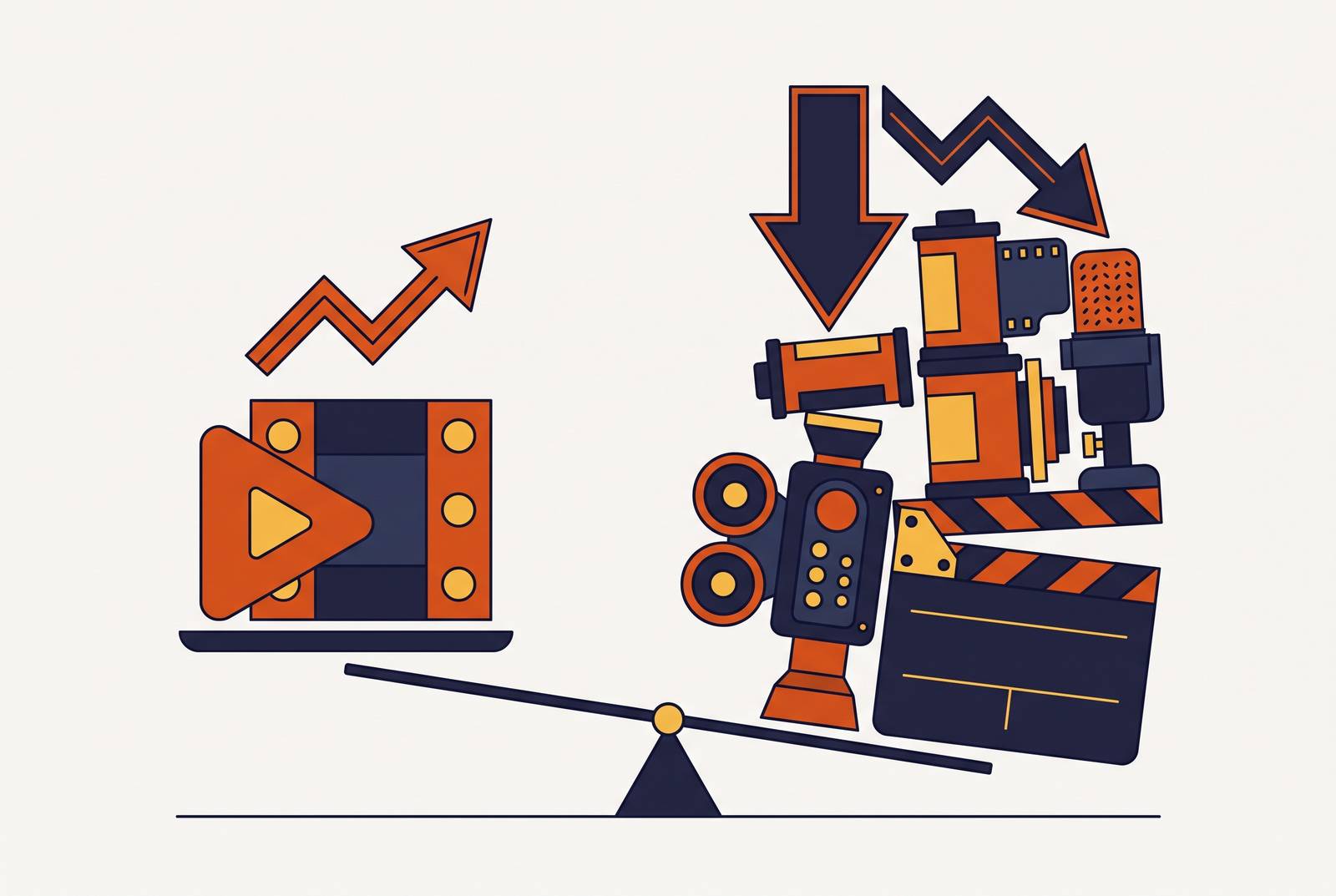
Agency pricing splits into three billable phases: pre-production (15 to 20% of budget), production (40 to 55%), and post-production (25 to 35%). Each phase gets billed on its own, and each carries its own timeline risk. Clutch puts the average agency project at $42,280.92. That's not the entry price, that's the average, so plenty of projects land well above it and almost none land far below.
AI platforms charge differently. Subscription tiers run $30 to $500 a month, and per-generation costs land between $0.50 and $30 per finished minute, depending on the platform and the quality tier. Human time doesn't disappear, but its job changes. Writing and refining prompts takes hours instead of days. Stakeholder review still happens, but a revision round that used to consume significant time now takes an afternoon, and post-processing shrinks down considerably.
Add it up and a comparable 60-second product video costs a fraction of the traditional range, delivered in 3 to 7 days instead of 3 to 6 weeks. Most teams still treat that gap as a style preference, something you pick based on taste. It's a budget decision, and getting that wrong is the actual mistake here, not a footnote to it.
The deeper shift sits in how the cost behaves, not just how much of it there is. Traditional video spend is large, lumpy, and tied to one contract and one project's worth of risk. AI video spend is largely fixed and mostly cut loose from how many videos actually get made. There's a volume line worth knowing too. An in-house traditional team only turns cost-efficient somewhere around 8 to 12 videos a month. Below that line, every video gets priced at a premium, whether the invoice admits it or not.
The four scenarios where the cost gap becomes undeniable
A single product video. A short SaaS or e-commerce showcase can cost several thousand dollars traditionally, with a multi-week timeline and revision rounds billed on top. AI generation plus human time totals a small slice of that, delivered in 3 to 7 days. Traditional still wins when the footage needs real hands on a real product, or the brand story leans on live-action authenticity that synthetic video can't fake. That's the honest exception here, not a hedge people add to sound balanced.
Social ad variants for A/B testing. Budget pressure usually caps traditional production at a handful of variants across 4 to 8 weeks, with every revision adding cost on top. AI drops the marginal cost of one more variant close to nothing, and that matters because only 4 to 8% of tested ad creatives ever become winners. The number of shots taken is the real lever here, not the polish on any single shot. Sovran's benchmark puts creative quality at 56% of the sales lift from digital campaigns. Read that plainly: the winning variant carries more weight than any single polished one, and AI is the only practical way to test enough variants to find it before the budget runs dry.
A 20-episode training series. Traditional costs scale straight up with episode count, and updating one episode later costs enough that most series just age out of date instead of getting fixed. AI holds the same model settings across every episode, so visual consistency comes close to automatic, and updating episode 14 six months later barely registers as an expense. Series content is close to the cleanest use case AI video has, full stop.
SaaS onboarding at scale. Roughly 75% of new SaaS customers churn in the first week, often because onboarding doesn't teach them the product fast enough. Meanwhile a large share of users prefer learning from short video over written documentation. That's a lot of short, high-volume content, which happens to land exactly where AI's cost curve goes flat. Teams using AI video tools report producing 5 to 10 times more content with the same headcount, and the bottleneck stops being "can we make this" and turns into "can we decide fast enough what to make."
Why localization is where the ROI case becomes mathematically impossible to ignore
Traditional localization doesn't scale. It multiplies. Each new language means a new voiceover artist, a new lip-sync pass, updated on-screen text, and a cost that climbs at best in a straight line with every market added, worse once scheduling and revisions get involved.
The numbers make the case without much help needed. Localizing 50 training modules into 10 languages costs $2 to $4 million through traditional production, versus $400,000 to $950,000 with AI localization: a cut of 70 to 76%, according to Miraflow research. Even a single training video localized into multiple languages the traditional way carries substantial cost before a single revision round happens.
AI flips the model underneath all of that. One script, one production pass, then language generation at the click of a button, so cost stops scaling with the number of markets served at all. Timelines compress from months down to days. Quality has caught up too: modern AI localization platforms hit accuracy solid enough for business and training content, with native-speaker review available for anyone who wants to close the last gap by hand.
For any company with customers or employees spread across multiple countries, localization isn't a line item buried near the bottom of the budget. It's often the single largest cost in the whole production plan, and most budget conversations still treat it like an afterthought instead of the thing quietly eating the biggest share of spend. AI is what removes it as a ceiling on how far the content can travel.
How volume and compounding output change the ROI calculation structurally
Cut production budgets by 60 to 80% and multiply output by 5 to 10 times, and ROI per dollar doesn't just improve. It compounds. AI video's savings in cost and time show up consistently across vendor and analyst reporting, but the savings figure is almost the less interesting part. What matters more is what teams do with the capacity they get back.
Enterprise AI video spending grew 127% year-over-year in 2025, and 73% of Fortune 500 companies have already folded AI video tools into their workflows. Adoption at that scale isn't trend-chasing, whatever the skeptics want to call it. It's what happens when finance teams with real budgets already ran this math internally and came out convinced.
A few compounding effects are worth naming directly. Teams that iterate faster find their winning creative sooner, and since only a small slice of tested creatives ever scale, speed of testing is itself the edge. Content libraries built at AI speed stay current, while libraries built at traditional speed are often out of date before the last episode even ships. Customer education content produced at real volume raises activation and cuts support tickets, and companies with structured onboarding report a 63% year-over-year jump in satisfaction. Every dollar spent on onboarding returns roughly five on average, and since video is the format most users prefer for onboarding, production speed feeds straight into that multiplier.
One structural fact sits underneath all of it: an agency can't match AI's output at any price, because agency cost is built entirely on human hours billed one at a time. AI's marginal cost per extra video approaches zero once the subscription is already paid for, and no amount of agency efficiency changes that math.
Where traditional production still earns its cost
None of this makes traditional production obsolete, and pretending otherwise is its own kind of dishonesty. Certain jobs still call for it, plainly and without much debate. High-end brand commercials that need cinematic storytelling, real talent, and live-action craft still belong to traditional production, and so do live events that can't be recreated synthetically, or content built around physical product interaction, hands-on hardware demos being the clearest example. Enterprise campaigns or TV commercials that run $50,000 to $500,000+ also tend to stay traditional, because at that tier, the production value itself signals brand quality to the audience watching it.
AI, meanwhile, clearly owns training videos, product explainers, onboarding walkthroughs, social content, SOPs, and multilingual variants: the high-volume, high-iteration content that makes up most of what software teams actually produce week to week. Most teams frame this as which method wins in the abstract, and that's the wrong question. The right one is which method fits the content sitting in the queue right now, and most of that queue lands squarely in AI's column. Plenty of teams run both, traditional for the flagship brand moment, AI for everything else, and that split holds up financially either way, since AI absorbs the volume work traditional pricing was never built to handle affordably.
A usable ROI framework for calculating the switch in your own context
The formula fits on the back of a napkin: take the net benefits of AI video (cost savings, output gains, time recovered), subtract the platform cost, divide by the platform cost, multiply by 100. It mirrors the standard onboarding ROI formula: (net benefits of onboarding minus onboarding costs) divided by onboarding costs, times 100.
A few real inputs turn this from theory into a number worth trusting, not a guess dressed up as math. Current per-video spend counts both the direct cost and the hidden one: revisions, coordination time, reshoot risk. Current monthly video volume gets set against the volume actually wanted, not the volume that's merely tolerated. The number of languages the content needs to reach matters, as does the internal hourly cost of whoever manages production coordination, and the revenue impact of production delays around launches, onboarding, or sales enablement.
After the switch, the metrics worth tracking aren't production metrics at all. Activation rate, time-to-value, 90-day retention, customer lifetime value: those tie a video decision to an actual business outcome, instead of just a cheaper invoice.
A few questions cut through the marketing fast when sizing up a platform. Does it handle the content types the team actually produces, things like explainers, SOPs, onboarding flows? Does it cover the languages customers and employees actually speak, without turning localization into its own side project? Can someone with zero video training produce a clean result alone, or does a specialist still need to sit at the controls? Does it produce documentation alongside the video, or does written content become a second, separate workflow bolted on afterward?
A few names are worth knowing here. HeyGen handles avatar and lip-sync work, available across multiple subscription tiers. Pictory turns a script or article into video, built for social and marketing use. Runway does generative, cinematic-quality video, with subscription tiers starting at $12 a month. Each one fits a different slice of the problem, and none are interchangeable, so the right pick depends on which content type is actually piling up first.
For teams focused specifically on software product education, walkthroughs, SOPs, onboarding video, documentation that needs to exist in more than one language, the platforms built around turning a screen recording directly into a finished video and a written article in the same pass are where the ROI compounds fastest. One recording session, two outputs, no separate documentation project bolted on afterward.
The real case for AI video was never just about spending less on one video. It's about what becomes financially possible at scale: fifty training modules in ten languages, updated weekly instead of once a year. Work that traditional production could never justify on a budget sheet becomes, under this model, just Tuesday.
Sources
- Video Production Costs in 2026: Traditional vs AI (Full Breakdown)
- AI Video Solutions for Enterprises
- The Real Cost of AI Video vs Traditional Production: A 2026 ROI Breakdown - Genra.ai
- Video Ad Production Cost in 2026 — Pricing Benchmarks | Sovran
- AI Video Ads Cost vs. Traditional Production: A Real Breakdown for Ecommerce Brands
- AI Video Production Agency: The Complete 2026 Guide | Stari Vuk Blog
- miraflow.ai