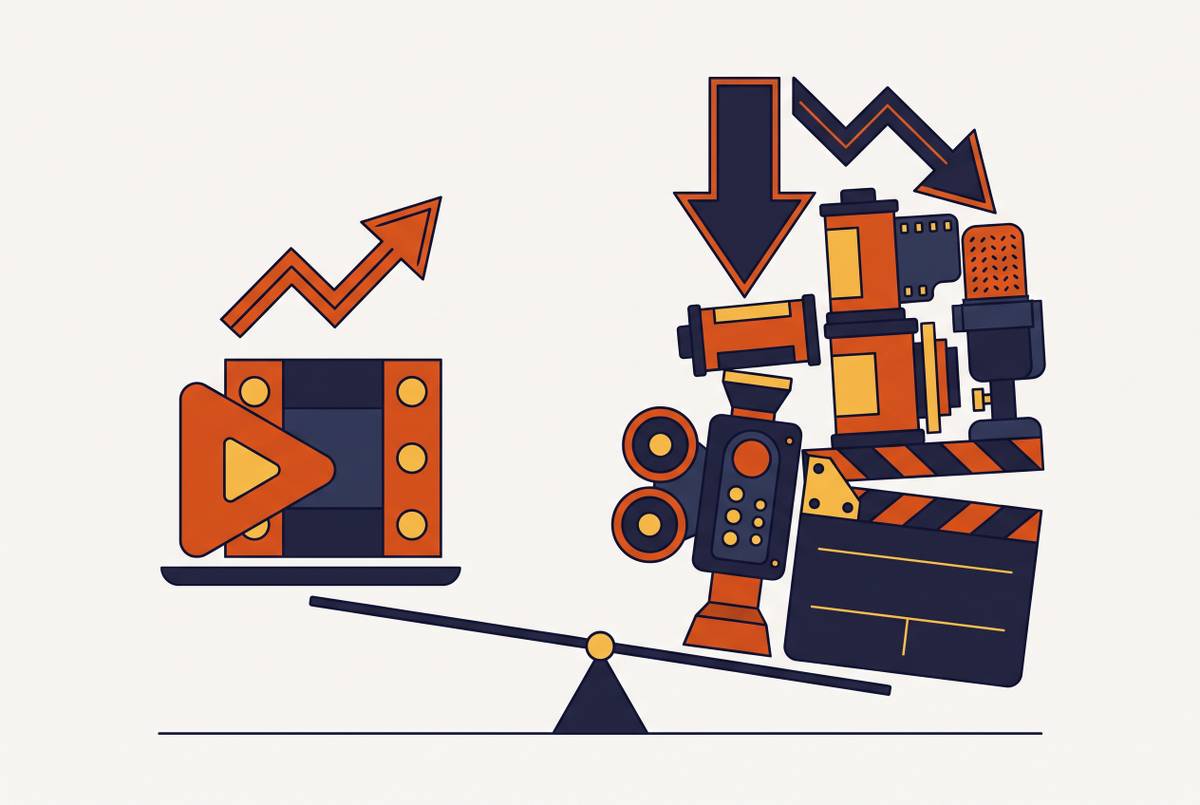
Lifelike AI Voiceovers vs Human Narration in Product Videos
AI voiceovers work best for tutorials; humans still win on emotional storytelling.
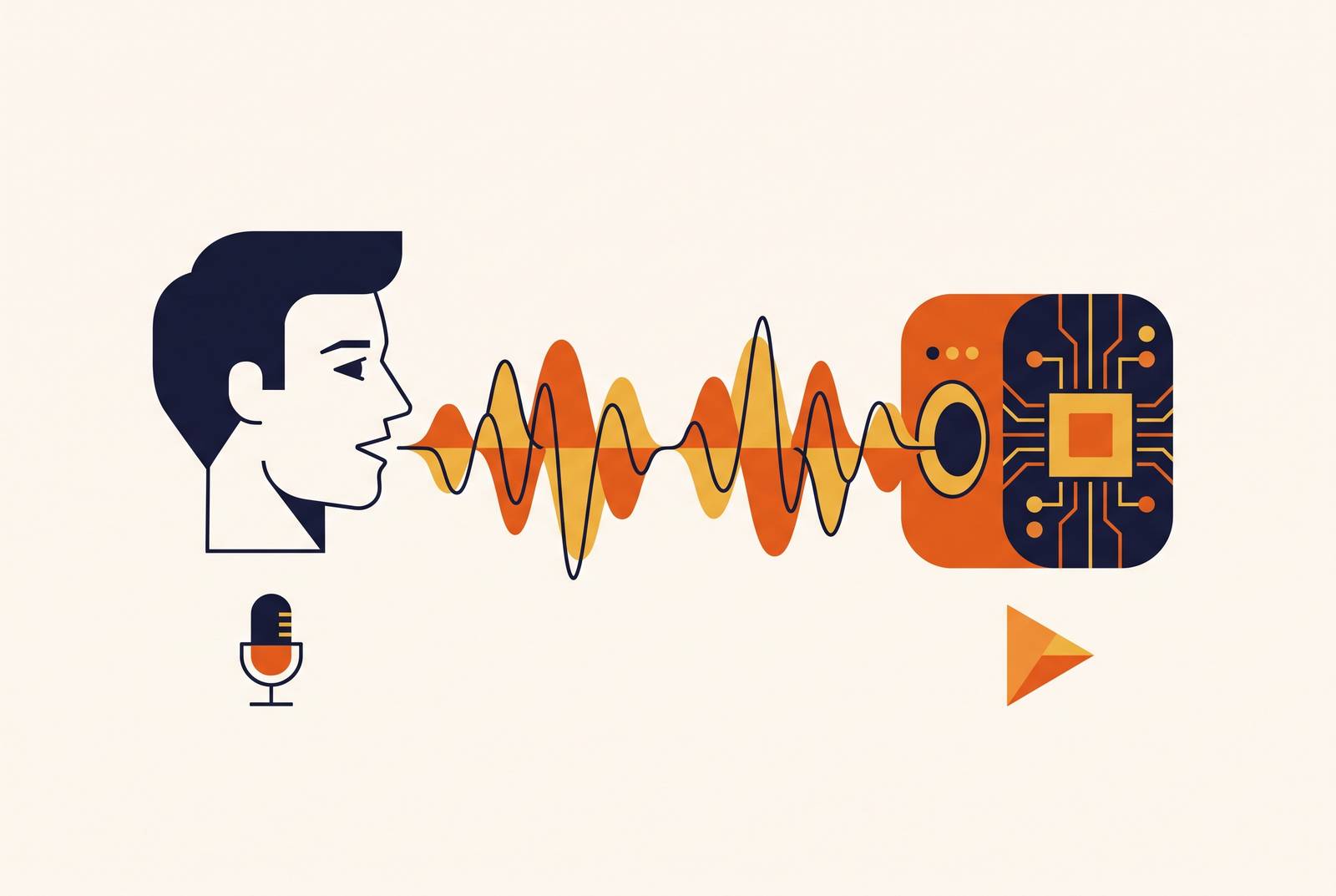
Choosing between AI voiceovers and human narration for product videos has largely stopped being a quality question. The real question now is a use-case question: which content type actually needs a human voice, and which just needs a clear one? Software teams that keep treating this like a debate over "better" are spending money they don't need to spend, or worse, cutting corners on the one video where a human voice actually matters.
Procedural content, product tutorials, onboarding flows, FAQ walkthroughs, internal training, and multilingual versions of existing videos are the clearest fits for AI voiceover, because the goal is clarity and consistency rather than feeling. Human narration still earns its cost for brand identity videos, sales demo videos meant to close deals, investor and customer story narratives, and anything where humor, irony, warmth, or grief has to land exactly right. The specific failure mode of AI voice is not general quality but interpretation: it cannot slow before a punchline, let a word catch, or shift tone the way a person does unconsciously, so it flattens precisely the moments where persuasion and storytelling depend on it most. Research on advertising also shows only 13% of consumers trust fully AI-made ads compared to 48% for human-supported ones, while 73% of consumers trust AI narration in instructional contexts, making the content type, not the voice technology itself, the variable that actually determines whether AI voice holds up.
What AI voiceovers actually do well now, and where they still flatten out
Premium AI voices, trained on huge sets of recorded human speech, now handle pacing, breath placement, and tone shifts well enough that the gap from a hired narrator has narrowed considerably. That wasn't true five years ago. It's true now, at least for one specific kind of speech: steady, instructional delivery where the goal is clarity, not feeling.
Here's where it still comes apart: irony, warmth, hesitation, comedic timing, urgency. These aren't small gaps. They're the exact spots where a script asks the listener to feel something rather than just understand something, and feeling requires interpretation. A human narrator reads a line and decides, consciously or not, to slow down before the punchline or let a word catch in their throat. An AI model reads the same line and delivers it at the same evenness it delivers everything else. The flattening isn't random. It shows up precisely where persuasion and storytelling depend on it.
For a product tutorial, none of that matters much. Nobody needs the narrator explaining a settings menu to sound moved. But for anything meant to build a brand feeling, a origin story, an emotional pitch, the flatness becomes obvious fast.
Voice cloning changes the calculation in a different way. Platforms built for this can take a recorded human voice and reproduce it across new scripts and new languages, keeping a single, recognizable voice as the face (or ear) of a brand without paying a narrator to sit in a booth for every new release. That's not a small capability. Hired talent can't scale that way, full stop; a person can only record so many hours before it costs a lot more.
The real cost gap between AI voiceovers and human narrators
Start with the human side of the ledger. A single 60-second professional voiceover typically runs $250 to $500 before revisions, usage rights, or extra languages get added in. Rates vary by format: social ads run $80 to $300, YouTube videos $50 to $500, e-learning narration $0.10 to $0.35 per word, and national TV spots start around $800 and climb fast.
AI pricing looks nothing like that. Free tiers usually cover around 10,000 characters a month, enough for a handful of short scripts. Paid plans run $5 to $99 a month, and premium tiers with cloned voices and commercial licensing land between $99 and $330 a month. Once a team is subscribed, the cost of generating one more voiceover is close to nothing.
Research from Trainn puts the savings at 90% or more compared to hiring talent, once volume kicks in. Localization is where the math gets almost absurd: dubbing a 60-second video into eight languages through a traditional studio can run $8,000 to $15,000 and take three weeks. An AI pipeline brings that down to a few hundred dollars, in a fraction of the time. One example from industry research: a global tech company localizing 100 training videos, each 45 to 60 minutes long, into seven languages. The traditional route would have cost around $1 million. The AI route brought it to roughly $1,500 per video, an 86% reduction.
None of that means cost is the only variable worth weighing. A single video carrying real emotional weight, an investor pitch, a brand launch, might justify the human premium regardless of what the spreadsheet says. But for a team shipping dozens of videos a quarter, AI is the obvious starting point, not an experiment.
Where AI voiceovers belong in a product video workflow
Certain content types are close to a perfect match for AI narration:
- Product tutorials and how-to walkthroughs, since the content is procedural and gets rerecorded often
- Internal training and onboarding videos, where speed and consistency beat charm
- FAQ and support videos, which need high volume on a low budget and get revised constantly
- Short internal tool walkthroughs that go stale the moment the UI changes
- Multilingual training content, where hiring native speakers for every target language was never realistic on a startup budget anyway
Update frequency is the piece that gets overlooked. A UI changes, a feature gets renamed, a workflow adds a step, and suddenly the old tutorial is wrong. Regenerating an AI voiceover to match takes minutes. Fixing a human recording means re-booking a studio, hoping the narrator's voice hasn't changed, and paying for another session. Research from ltx.io found teams using AI video tools producing five to ten times more content with the same resources, with the bottleneck shifting away from production and toward decision-making.
There's a consistency payoff too. A 50-video training library narrated by AI sounds like one narrator did the whole thing, because one narrator, in a sense, did. Wyzowl's 2026 research found 93% of video marketers say video increases customer understanding of a product, and AI is what makes it affordable to cover every feature, not just the handful worth a studio budget. Given the well-documented role of poor onboarding in early customer churn, covering every workflow step in video, cheaply, isn't a nice-to-have.
Which product video types actually need a human narrator, and where does AI voice fall flat?
Some content genuinely needs a person behind the microphone:
- Brand identity videos and executive communications, where the voice carries the personality
- Sales demo videos meant to close deals, where trust and emotional connection influence the outcome
- Investor or customer story narratives, which need warmth and the ability to react to meaning, not just words
- Anything where humor, irony, or grief has to land exactly right
The trust research backs this up, with a caveat worth repeating. A study published in the Journal of Retailing and Consumer Services (2024), using conversion data from short-video platforms, found AI voiceover ads underperformed human voiceover ads. That's an advertising finding, not a tutorial finding, and the distinction matters. Research from realvotalent.com found 48% of consumers trust ads co-created by a person using AI support, compared to just 13% for fully AI-made ads. Human involvement itself functions as a trust signal in persuasion contexts.
But separate research on instructional content, tutorials, support videos, similar formats, found 73% of consumers trust AI avatars there. A striking contrast, and one tied closely to context. The trust gap is real, but it's tied tightly to context, and applying ad-context skepticism to a help-center video is a mistake that costs money for no benefit.
There's a legal angle too, often ignored until it's a problem. A human narrator signs a contract spelling out usage rights: duration, geography, media type. AI voice licensing is murkier, tangled up in training-data disputes and voice-likeness claims, and platform terms vary in ways that can quietly prohibit broadcast use. For a high-stakes, low-frequency video where the brand's reputation is riding on it, that legal clarity alone can justify hiring a person.
Why audience perception of AI voice depends heavily on content type and viewer demographics
The perception gap in advertising is wide and getting wider. Research from realvotalent.com found 82% of ad executives believe consumers feel positive about AI-made ads, but only 45% of consumers actually do, a 37-point gap, up from 32 points in 2024. CivicScience found consumers 36% less likely to buy from brands using AI in ads in 2025, up from 32% the year before. Executives are misjudging their own audience, and the gap is growing, not shrinking.
None of that applies cleanly to a tutorial. Research from lipsynthesis.com found 58% of Gen Z and Millennial viewers find AI video content informative or entertaining, and that's the exact demographic most likely to be watching a SaaS product walkthrough. Separately, 73% of consumers report trusting AI avatars, based on 2025 research. Someone scrolling past an ad and someone actively trying to learn how a feature works are not in the same headspace, and they don't judge the voice the same way.
One more wrinkle. Research on AI-generated content has found that labeling it as such can erode trust on its own, regardless of quality. Disclosure isn't automatically a credibility boost. So the practical takeaway for a product team is straightforward: audience mindset changes the trust calculus more than the voice itself does, and treating a tutorial like an ad, worrying about the same perception risks, leads to overspending on narration nobody needed.
How hybrid workflows combine both options without doubling the workload
Industry data from a 2024 localization survey found 43% of Language Service Providers already running hybrid AI-human workflows for dubbing and subtitling. The pattern has more or less settled: record a human narrator once for the primary English version of a brand video, then use AI dubbing to generate voice-matched versions in every other language, using the human recording as the reference.
A second pattern fits SaaS teams specifically: human narration for the flagship product demo or homepage video, AI narration for everything downstream, tutorials, onboarding, training modules. Voice cloning bridges the two. Cloning tools can take that original human recording and apply the same voice across an entire library of AI-generated content, so the brand voice stays consistent without re-booking the narrator for every new release.
What this changes operationally matters more than it sounds. The decision is no longer "AI or human" argued fresh for every single video. It becomes a one-time classification question: which tier does this content belong to? Flagship, mid-tier, or high-volume tutorial content? Platforms that combine script generation, voiceover, and documentation output in one workflow make that tiered structure workable without juggling separate vendors for each step. Industry experience with AI dubbing shows that running transcription, translation, and voice generation in parallel collapses localization timelines that used to run sequentially, and take weeks.
A practical decision framework for product video teams choosing between the two
Six variables decide most of this: content type (procedural or persuasive), update frequency, volume, audience (internal users versus prospects and executives), language scope, and stakes (what actually breaks if the video underperforms).
Sorted roughly by fit:
AI fits: product tutorials, help-center videos, onboarding flows, internal training, FAQ walkthroughs, multilingual versions of existing content, any high-volume content program.
Human fits: brand launch videos, executive demos for major prospects, customer story narratives, flagship homepage demos, anything where the emotional tone carries the message.
Hybrid fits: localized versions of a human-narrated anchor video, cloned-voice libraries for a tutorial series, AI-generated supplemental content sitting alongside one human-narrated core video.
Speed alone often settles it. AI turns a finished script into finished audio in minutes. Even a modest human narration project adds days, sometimes weeks, once scheduling, recording, and revision rounds are factored in. For teams shipping content on a regular cadence, customer education, L&D, sales enablement, an AI narration workflow folded into script cleanup, captions, and documentation removes the production bottleneck almost entirely.
Wyzowl's 2026 research found 63% of people say a short video is their preferred way to learn about a product. The demand for video coverage already exists. What's been missing is production capacity to match it, and that's the piece AI actually solves. Teams that treat AI narration as a production-layer decision, not a quality compromise, end up shipping more content, covering more use cases, and reaching more languages, without needing a full production team or a budget to match one.