Asynchronous vs Live Training for Software Onboarding
Design matters more than format in determining onboarding success.
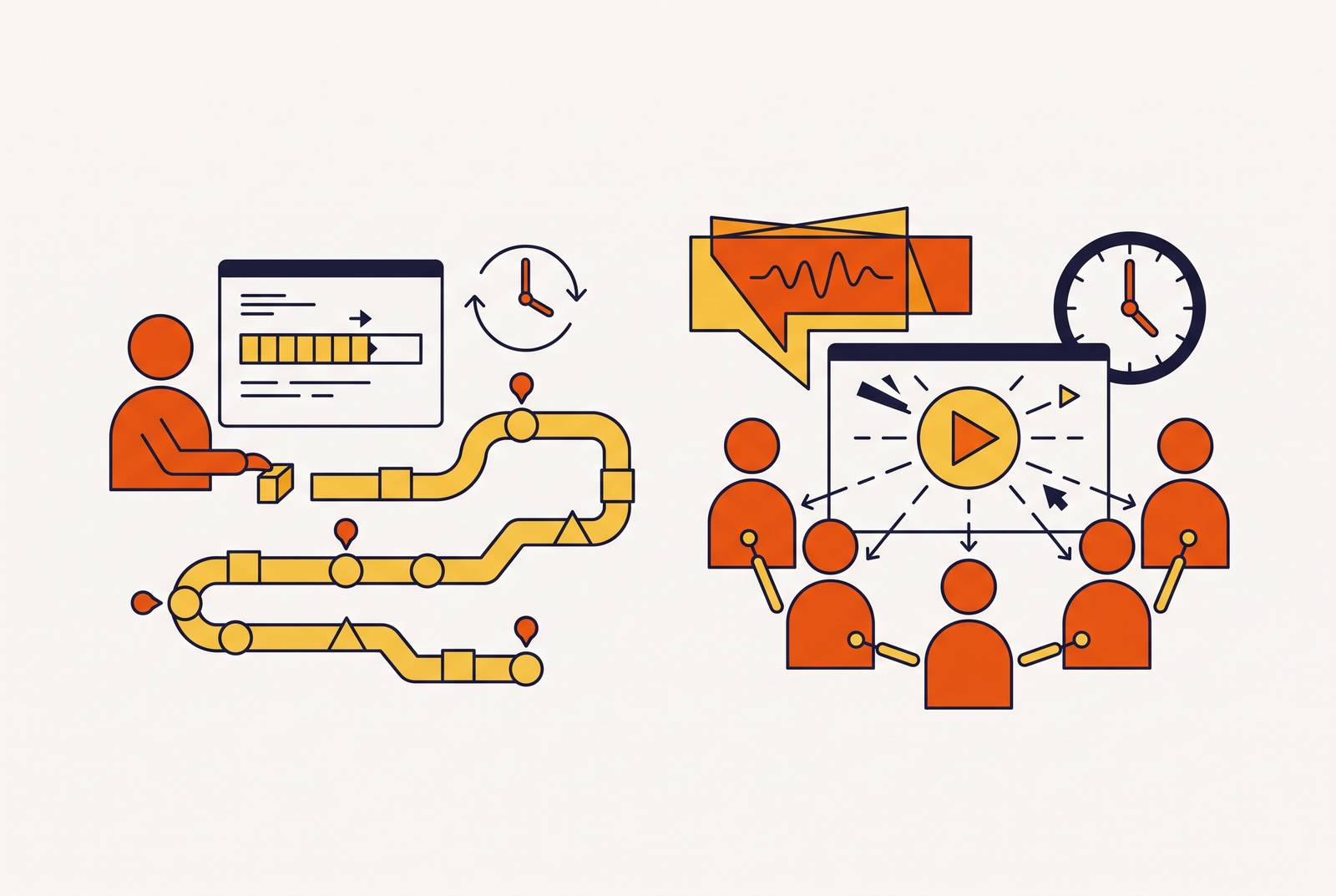
Most teams building a software onboarding program treat the decision as a fork in the road: live sessions or async content, pick one. That instinct makes sense on the surface, since the two formats feel different to run and different to sit through. But a 2025 randomized controlled trial published in BMC Medical Education found that synchronous and asynchronous formats produce comparable knowledge outcomes, and the format itself is not what separates a successful onboarding program from a weak one. Design decides outcomes more than delivery mode does.
The hidden cost of defaulting to live sessions for software onboarding
Defaulting to live sessions for onboarding creates a coverage problem that is visible weeks later, in metrics nobody traces back to the original training decision. The average live training session has a 30 to 40% attendance rate, and the other attendees missed it, and most of them never see the content afterward. That gap turns into slower customer onboarding, slower new-hire ramp time, and a customer success team stuck repeating the same walkthrough to each person who missed the live version.
Timing makes this worse than it looks on paper. The first weeks after a customer signs up are the highest-risk window for churn, and research cited by Tami identifies this period as the one where a significant share of that churn originates. A strong onboarding-education flow is the intervention that protects that window. A live-only program that reaches 30 to 40% of new customers in their first critical weeks is, by construction, leaving the majority of that risk unaddressed.
Where async onboarding works
Async onboarding is well suited to the material that doesn't change week to week and that people need to come back to more than once. Foundational software walkthroughs, compliance modules, SOP review, and process documentation all fall into this category, since learners benefit from referencing them repeatedly rather than absorbing them once in a live room. The consistency that comes with this is structural: every new hire or new customer gets the same training experience, regardless of what time zone they're in or which cohort they joined.
For HR and L&D teams, this consistency has a direct operational payoff. Async materials cut down the repetitive work of running the same live session for every new group, which frees up human time for the kind of personalized support that actually needs a person. But async content only delivers on this if people actually watch it, and that's where the format runs into its real limit. Attention research, most notably a large-scale edX study, suggests engagement drops sharply after around six minutes of continuous content, though the exact threshold varies by context. That finding is a design constraint: it means onboarding content needs to be built in short, modular segments rather than as long recorded sessions that mimic a live training hour.
Live interaction: where it's genuinely required
The strongest onboarding programs don't treat live and async as competitors. They assign each format to the type of moment it actually handles well, and that assignment happens at the design stage, before a single session gets scheduled. Live formats earn their place when interaction itself is the point: team introductions, hands-on practice that needs real-time feedback, mentoring conversations, leadership cohorts, and the kind of cultural immersion that only works with people present at the same time.
Everything else belongs in async. Foundational product knowledge, compliance, software walkthroughs, SOP documentation, and reference material that learners will need again later all fit the format that doesn't require real-time exchange. For software onboarding specifically, the most common misallocation is using a live session for content people need to revisit, the "let me show you how this works" explanation that should live as a polished on-demand video rather than a one-time webinar. Step-by-step walkthroughs and software demonstrations are ideal candidates for async video and accompanying documentation, since those formats let learners pause, rewind, and come back to them exactly when the skill becomes relevant.
Some teams push back here, arguing that live sessions build in accountability that async content lacks. That argument misunderstands where accountability actually comes from. Completion tracking, progress reporting, and automated reminders are features built into well-designed async systems, not something exclusive to a live room. eLearning Industry's 2026 onboarding software directory names progress tracking and reporting as a core feature of async onboarding platforms for exactly this reason.
Why production quality determines whether async content gets used
Strategy aside, async onboarding has historically run into a practical wall: producing content good enough that people actually watch it takes time and skill that most teams don't have sitting around. A raw, unedited screen recording is the most common async artifact, and it's also the least effective one. It runs long, looks unpolished, and tells the learner, implicitly, that nobody thought this was worth their attention.
A properly produced training video, with a clean script, clear narration, smart zoom on the parts of the interface that matter, and captions, holds attention in a way a raw recording simply doesn't. The bottleneck has always been production time: building a short training video the traditional way meant hours of scripting, recording, editing, subtitling, and revising. Analysis of AI-assisted production pipelines has cut that down to roughly 45 to 60 minutes. That shift is what makes async-first onboarding workable for teams without a dedicated video production function, since the heavy editing work gets handled by the tool rather than by a specialist, letting any subject-matter expert produce content at the pace the program actually needs.
Speed without oversight creates its own risk. Practitioners in 2026 are explicit that AI-accelerated production still requires the same quality controls as any other training workflow. A course built fast but reviewed poorly is still an inaccurate course, and AI tools don't replace needs analysis, subject-matter review, or accessibility checks, they just remove the time penalty for doing the production work well.
AI-assisted tools for producing polished async software training content
Teams building an async-first program need a production workflow that keeps up with software that changes constantly and a content library that keeps growing, without requiring a specialist on staff for every video.
Clueso is built around exactly this problem: it turns raw screen recordings into professional-looking videos with clean narration, smart zoom, and captions in minutes rather than days, which directly targets the production bottleneck that keeps so much async content stuck at the "unedited recording" stage. That turnaround time lets a team produce a video every time a feature ships instead of one onboarding video a quarter.
Screen recording tools, Camtasia among them, remain the standard for software-specific training where the whole point is showing the exact interface a learner needs to navigate. No AI-generated animation matches the specificity of an actual product walkthrough captured directly from the software itself. These tools work best as the capture layer inside a broader editing and production workflow, rather than as a standalone way to publish a recording exactly as it was captured. In other words, the capture tool and the production layer solve different problems, and a mature async program usually needs both.
Format and production decisions for sales enablement and customer onboarding
Sales enablement and customer onboarding are the two places where getting the format decision wrong has the clearest price tag attached. The async demo world has already sorted itself by funnel stage: interactive demos work as top-of-funnel embeds on a website, video demos serve mid-funnel sales enablement and social proof, and live demos do the actual closing work in bottom-of-funnel conversations. Using one format across all three stages misallocates attention and leaves conversion on the table. A sales team that tries to run every stage of that funnel through a live demo, or tries to close deals with a pre-recorded video, is fighting the format rather than using it.
Sales rep onboarding follows a similar logic. An async coaching loop, where reps record practice pitches, managers give async feedback, and the strongest recordings become training material for the next cohort, is proving effective for distributed sales teams. G2's Summer 2026 Grid Report identifies Allego, built for video-based coaching and peer learning, and SalesHood, built for scaling onboarding across teams, as the platforms where this motion is most developed, with both earning strong coaching ratings from verified users.
On the customer side, video-based product education protects the same early-churn window described earlier. UserGuiding's data shows SaaS companies using video onboarding see meaningfully fewer support tickets in the first month after signup. That pattern holds at the program level, too: organizations that formalize customer education see increases in both product adoption and retention, and most report a positive return on investment, according to Intellum and Forrester research across programs of different sizes. None of this works, though, if the content built for these moments sits unused. Forrester has found that most marketing-created content never gets used at all, a finding that applies just as directly to sales enablement libraries built without a clear sense of which format serves which stage.
Localization as the test of whether an async program scales globally
A content library that only exists in English is an English-language onboarding program that happens to live on the internet. That distinction matters because a large and growing share of e-learning is delivered in languages other than English, with Vozo's analysis noting that nearly half of e-learning will be delivered in non-English languages by 2026. An English-only software demo is a bottleneck for global deployment.
The old localization workflow meant rebuilding the training from scratch for every region, a separate project with its own timeline for each language. The AI-assisted alternative translates a single master asset and distributes language versions from it, so one onboarding video can serve several markets at once instead of one. This shift is already built into enterprise LMS infrastructure: D2L's 2026 guide to multilingual LMS platforms notes that TalentLMS supports course translation in more than 40 languages through its AI Translator, and that Cornerstone's Skills Graph is available across a range of languages.
Speed here doesn't eliminate the need for a human check. AI-generated narration can drift from the exact product terminology, compliance language, or process details a company depends on, so localization done quickly still needs review before it ships. Clueso's one-click translation across more than 33 languages is built around this exact constraint, aiming to make sure global teams aren't stuck waiting on a separate localization project before they get access to training everyone else already has.
Measuring whether the format mix is working
A format mix earns its keep when the numbers tied to the original problems move, not when the program simply looks more sophisticated on paper, and attendance and completion rates for async content should be tracked against the 30 to 40% live-session attendance baseline, since the other attendees missed it and most never see the content afterward. Time-to-ramp for new hires and time-to-first-value for new customers are signals of whether the format decisions are landing correctly, particularly in the first weeks after signup, which research cited by Tami identifies as the highest-risk window for churn.
Support ticket volume in a customer's first month is a direct, measurable proxy for whether video-based onboarding is doing its job, since teams with strong video onboarding already see meaningfully fewer tickets in that window. On the sales side, adoption and retention figures tied to formal customer education programs give a read on whether the content is actually driving the outcomes the program was built around, rather than just existing as a library nobody opens. None of these numbers require guesswork. They're the same metrics the live-only model was already failing to move, which makes them the right baseline for judging whether the format-plus-production approach described here is actually working.